
The Internal Power Meter
Or: How to train properly when you don't have power or pace.

NOTE THAT ALL ZONES MENTIONED HERE ARE MY NEW ZONES. Don’t try to move this across 1:1, it needs to be translated first if you aren’t using my zones!
We’ve talked about the basics of what intensity metrics and zones are in this post. But really, measuring intensity in only one way is always liable to give you errors in your data at some point. If you only measure Input you can end up missing signs of over-training. If you only measure Outputs,… well then you can also end up missing signs of over-training!
Because the body (which includes the head, you reductionists) is so fucking complicated, it’s optimal to have three different measurements of intensity at all times. The gold standard of intensity measurement is a triangulation of Output, Input, and Subjective.
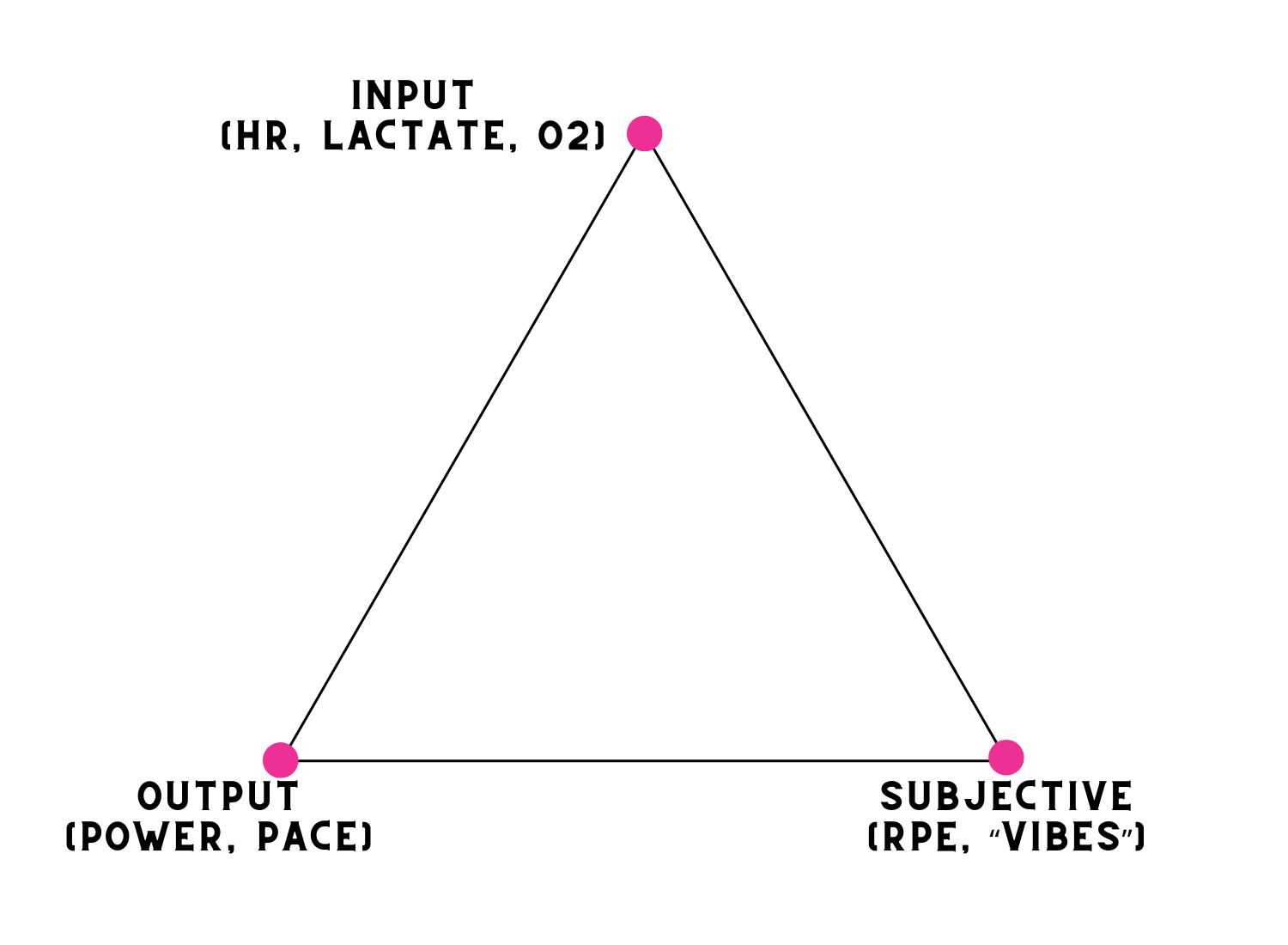
We’ve already talked a fair bit about the Inputs and Outputs in the zones post, so today is all about the Subjective values.
OK, let’s get this out of the way: None of these (Input, Output, or Subjective) are better or worse. None of them is best in all cases. These are all tools that have more weight/use/benefit/cost in different situations with different athletes.
I will say this though. Generally it’s better to have two of these instead of one. This is why I think it’s really important for mountain athletes to get pretty good at the Subjective measures, as you almost certainly don't have power or pace (no, running power and/or pace in the mountains doesn’t work).
The Internal Power Meter
As we chatted about in the Zones post, when I’m prescribing an intensity of training, what I’m really aiming for is certain results in the muscle. I’m look for the control of intensity in individual contractions, or the individual contraction Output. The accumulated and lagging indicator of these contractions is the Input intensity that you’re measuring. But what happens when you only have the Input? For example, I can’t tell you how many times I’ve talked to athletes who said “Well, I couldn’t stay in Z1, so I kept adding in walking breaks to keep my HR in Z1.” You know whats happening in that case? They’re running the whole time at Z2 Output, and then walking at Z0 Output, in order to keep in Z1 Input! How much time are their muscles spending at Z1 Output?? None! This matters!
To combat this problem, I recommend you spend time calibrating your internal power meter, or using your subjective measures as a kind of Output-Proxy. Many athletes right off the bat aren’t great at this, but many get quite good with time. Here’s a rough method that I just made up:
This is two parts, which I recommend doing as the two hard workouts in a week.
Part 1: Ramp Test
Pick a mode that allows you to control Output metrics. For runners this is a treadmill. For MTB’ers without a power meter, do this on a trainer indoors. If you mostly run flat, keep the treadmill flat. If you mostly run uphill, then kick up the grade.
Do a standard ramp test, using Output as the independent variable, and measuring what happens to your HR at each different output.
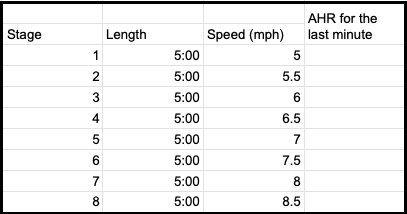
That last-minute Average HR (AHR) at the end of each stage tells you what the actual input for that workload is (and really it’s a low estimate).
Part 2: Feel Check
Perform a second test (a couple days later) where you’re using Outputs interpolated from the first test to figure out what the fuck does each zone feel like.
Based on the data you gathered from the first test, estimate what Output is in the middle of your HR zones. For example: Say that last-minute AHR on the 5.5mph stage is just at the bottom of your Zone 1 range, but at 6mph your HR was in the bottom of Z2, then we can guesstimate that at ~5.7mph you’re going to end up with a HR that’s just about in the middle of your Z1 HR zone. This doesn’t need to be exact, just ballpark something that you think will end up in the middle-ish of the zone.
Note that the Zone 5 speed should just be something 10-15% faster than your Z4 output.
Spend 5-10 minutes at each Zone Output and pay attention to your Subjective metrics within and between zones: How much can you talk? How is your breathing? How do your legs feel? Is it hot? Does your mindset change between zones? What feels different from Zone 1 output to Zone 2 output, etc?
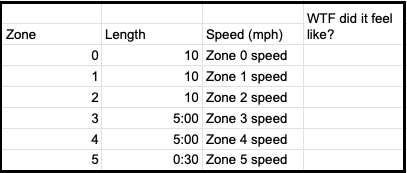
Write that shit down at the end of each stage.
Now, go out and practice that shit! Try to feel the zones and use the HR as a way to check. In the beginning, if you’re having a hard time with this, maybe you do that second test once a week for a while, just to get the hang of it. The goal is that each zone is baked into your brain in a way that you will never forget. An experienced athlete should be able to go out with a power meter and a HR monitor and ignore both of them and 95% of the time nail a whole interval workout in the correct HR and power without once looking at your HR and power.
If you aren’t already skilled at this (and I know some of you are), then this could be a pretty big thing for you! To have the confidence that you don’t really need to look at your watch or computer for a lot of a workout? To have the ability to look at your HR and say “shit, it really doesn’t feel like that,” and realize you’re tired and should probably go take a nap? These are not small things in the journey for gaining fitness!
I have a Coaching opening. Please read this post if you’re curious about working with me.